Sage 50 to QuickBooks Conversion: Complete Guide for a Smooth and Accurate Data Migration
As businesses grow, their accounting requirements often change. While Sage 50 has long been a trusted accounting solution for small and medium-sized businesses, many organizations are moving to QuickBooks to take advantage of its modern interface, automation tools, flexible reporting, and cloud connectivity. A successful Sage 50 to QuickBooks Conversion enables businesses to transfer financial records securely while maintaining the accuracy of their accounting data and minimizing operational downtime.
Whether you are upgrading your accounting system, simplifying bookkeeping, or preparing your business for future growth, understanding the Sage 50 to QuickBooks Conversion process can help ensure a seamless migration.
What Is Sage 50 to QuickBooks Conversion?
Sage 50 to QuickBooks Conversion is the process of transferring accounting and financial data from Sage 50 to QuickBooks Online or QuickBooks Desktop. The migration includes important business information such as the chart of accounts, customer and vendor records, invoices, bills, inventory, payroll, banking transactions, tax information, and historical financial data.
The objective is to preserve financial accuracy while allowing businesses to continue operating without interruption. A properly planned Sage 50 to QuickBooks Conversion ensures that reports, account balances, and transaction histories remain consistent after the migration.
Why Businesses Choose Sage 50 to QuickBooks Conversion
Many companies initially selected Sage 50 because it provided dependable accounting capabilities. However, as technology and business needs evolve, organizations often discover that QuickBooks offers greater flexibility and a more intuitive user experience.
QuickBooks is widely recognized for its easy navigation, making it simple for business owners, accountants, and bookkeepers to perform daily accounting tasks. The software also integrates with numerous third-party applications, improving productivity and streamlining financial management.
Another reason businesses invest in Sage 50 to QuickBooks Conversion is to gain access to automation features that reduce manual work and improve efficiency.
Benefits of Sage 50 to QuickBooks Conversion
User-Friendly Accounting Software
QuickBooks offers a clean and intuitive interface that allows users to manage invoices, expenses, payments, and financial reports with minimal training.
Powerful Financial Reporting
One of the major advantages of Sage 50 to QuickBooks Conversion is access to comprehensive financial reporting. Businesses can create Profit and Loss Statements, Balance Sheets, Cash Flow Reports, Sales Reports, Expense Reports, and customized management reports.
Increased Automation
QuickBooks automates recurring invoices, payment reminders, bank reconciliation, expense categorization, and transaction matching. These automation tools save time and reduce accounting errors.
Better Collaboration
QuickBooks Online allows business owners, accountants, and finance teams to securely access accounting data from anywhere, improving communication and collaboration.
Scalable Business Solution
As your organization grows, QuickBooks can accommodate more users, higher transaction volumes, and expanding operational requirements without requiring a complete software replacement.
Data Included in Sage 50 to QuickBooks Conversion
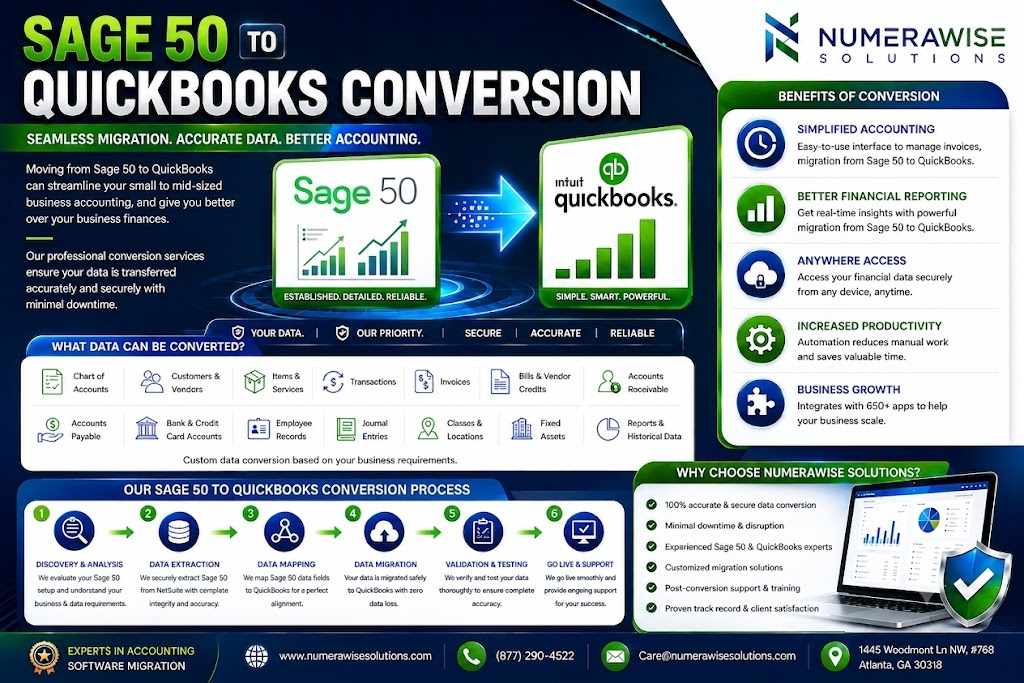
A professional Sage 50 to QuickBooks Conversion generally includes:
Chart of Accounts
Customer Records
Vendor Information
Products and Services
Open Invoices
Bills and Payments
Bank Transactions
Credit Card Transactions
Inventory Records
Payroll Information
Tax Data
General Ledger
Historical Financial Transactions
Sales History
Purchase History
Opening Balances
The exact information transferred depends on the structure of your Sage 50 company file and the QuickBooks version selected.
Step-by-Step Sage 50 to QuickBooks Conversion Process
1. Review Existing Financial Data
The first step is evaluating the Sage 50 company file to identify duplicate records, inactive customers, outdated vendors, and unnecessary transactions before migration.
2. Create a Complete Backup
A secure backup of the Sage 50 database is created before the migration begins. This protects valuable accounting information throughout the conversion process.
3. Clean the Accounting Data
Removing duplicate records, correcting inconsistencies, and archiving inactive accounts improves the quality and accuracy of the migration.
4. Map Data Fields
Each Sage 50 data field is carefully matched with the corresponding QuickBooks field to ensure that reports, balances, and customer information transfer correctly.
5. Transfer Financial Data
Specialized migration tools are used to transfer accounting records into QuickBooks while preserving historical transactions and maintaining financial integrity.
6. Verify the Migration
After the transfer, accountants compare account balances, trial balances, customer balances, vendor balances, and financial reports between both systems.
7. Configure QuickBooks
Company preferences, user permissions, tax settings, payment methods, and reporting options are customized according to business requirements.
8. Test the New System
Users perform daily accounting activities such as invoicing, expense recording, inventory management, bank reconciliation, and report generation to verify that the system functions correctly.
9. Go Live
After successful testing and validation, QuickBooks becomes the company's primary accounting platform.
Common Challenges During Sage 50 to QuickBooks Conversion
Although Sage 50 to QuickBooks Conversion is a well-established migration process, businesses may encounter challenges due to differences in account structures, inventory methods, payroll configurations, and customized reports.
Large company files and years of historical transactions can also increase migration complexity. Working with experienced conversion specialists helps identify these issues early and ensures that financial records remain accurate.
Best Practices for a Successful Migration
To ensure a successful Sage 50 to QuickBooks Conversion, businesses should:
Reconcile all bank and credit card accounts before migration.
Remove duplicate and inactive records.
Verify customer and vendor information.
Create multiple secure backups.
Review financial reports after migration.
Test all accounting workflows before going live.
Train employees on QuickBooks features.
Maintain documentation throughout the project.
Work with experienced migration professionals.
Following these best practices helps reduce errors and ensures a smooth transition.
Why Choose Professional Sage 50 to QuickBooks Conversion Services?
Professional Sage 50 to QuickBooks Conversion services help businesses transfer accounting information accurately while minimizing downtime. Experienced migration specialists understand the technical differences between Sage 50 and QuickBooks and use proven migration methods to preserve financial integrity.
Professional support typically includes project planning, secure data transfer, validation, reconciliation, troubleshooting, report verification, and post-conversion assistance. This ensures businesses can confidently begin using QuickBooks without interruptions.
Conclusion
A successful Sage 50 to QuickBooks Conversion allows businesses to modernize their accounting operations while preserving valuable financial information. QuickBooks provides an intuitive interface, advanced reporting capabilities, automation features, and flexible deployment options that support business growth.
By carefully preparing your data, validating financial records, and following a structured migration process, your organization can complete a Sage 50 to QuickBooks Conversion efficiently and accurately. Whether your goal is improved productivity, better reporting, or simplified accounting, QuickBooks provides a reliable platform that supports long-term success.
Frequently Asked Questions (FAQs)
1. What is Sage 50 to QuickBooks Conversion?
It is the process of transferring accounting and financial data from Sage 50 to QuickBooks while maintaining financial accuracy and historical records.
2. What data can be migrated?
Most accounting information can be transferred, including chart of accounts, customer and vendor records, invoices, bills, inventory, payroll, tax information, bank transactions, and historical financial records.
3. How long does the conversion process take?
The timeline depends on the size and complexity of the company file. Small businesses may complete the migration in a few days, while larger organizations may require additional time.
4. Will historical financial transactions be preserved?
Yes. A professional migration typically preserves historical transactions, allowing businesses to maintain complete financial reporting and business continuity.
5. Why should I migrate from Sage 50 to QuickBooks?
Businesses often choose Sage 50 to QuickBooks Conversion to benefit from easier bookkeeping, advanced reporting, automation, improved collaboration, flexible deployment options, and a scalable accounting platform that supports future growth.


Write a comment ...